

Source: Zman Yisrael (Israel Time)
By Pinhas Inbari
It is still not entirely clear what really lay behind Prime Minister Benjamin Netanyahu’s hurried trip to the Emirates last Sunday, but it may yet prove to be the turning point of the October 27 election.
If the opposition wins, it may turn out that this happened not thanks to its own dazzling performance, but because the revelations about the warnings Netanyahu received ahead of the Hamas attack completely derailed a campaign that had been painstakingly built over a long period, and left him standing before the wreckage.
According to sources quoted in Israel and abroad, Netanyahu asked the president of the Emirates at their meeting to deny the reports. Abu Dhabi issued no denial. Immediately upon his return, Netanyahu filed sweeping libel suits against leading newspapers and a string of journalists, which raises the question: did he seek the Emirati denial for the purposes of the lawsuit?
According to sources in Israel and abroad, Netanyahu asked the president of the Emirates to deny the reports. Abu Dhabi issued no denial. Immediately upon his return, Netanyahu filed sweeping libel suits. Did he seek the Emirati denial for the purposes of the lawsuit?
The spin doctors in Netanyahu’s office tried to create the impression that he had been invited to a regional discussion with representatives from Saudi Arabia, Libya, Egypt, Jordan and Morocco. The painful irony is that such a discussion should have taken place long ago, but Netanyahu’s coalition with the Kahanists made it impossible.
A new alignment is indeed taking shape in the Arab world, including a Saudi-Emirati reconciliation, and Libya’s chief of staff, Saddam Haftar, visited the Emirates at the same time as Netanyahu. But a meeting that would have been held as a matter of routine had Israel had a different government cannot be held now.
The Historic Bloc Has Run Its Course
Netanyahu understood long ago that the coalition that kept him in power – a Likud swallowed up by the black hole of violent Kahanism, together with the ultra-Orthodox who refuse to integrate into the state, to enlist and to work – had reached the end of its road.
That is what lay behind the removal of the Kahanist Knesset members from the Likud list, and the attempt to replace them with statesmanlike figures such as Gabi Ashkenazi, whose name appeared on Netanyahu’s dream list for reserved slots.
The first sign of the change now taking shape may be found in the fact that they turned the invitation down, and Netanyahu was forced to scrape up candidates from the bottom of the barrel, including bereaved parents who did not understand their role and, instead of speaking as statesmen, thought their job was to revile. The outstanding example is the bereaved father Itzik Bonzel, who was given a reserved slot on the list and said of Yocheved Lifshitz, a survivor of Hamas captivity, that he would like to send her back to Hamas, until Netanyahu forced him to apologize.
A sign of the change taking shape: Netanyahu’s picks for the reserved slots turned the invitation down, and he was forced to scrape up candidates from the bottom of the barrel, including bereaved parents who did not understand their role and, instead of speaking as statesmen, thought their job was to revile.
Netanyahu’s main breakthrough effort was to bring Gadi Eisenkot into his government, in order to build a new governing bloc that would replace the Likud–ultra-Orthodox–Kahanist bloc.
One Billboard in the Street
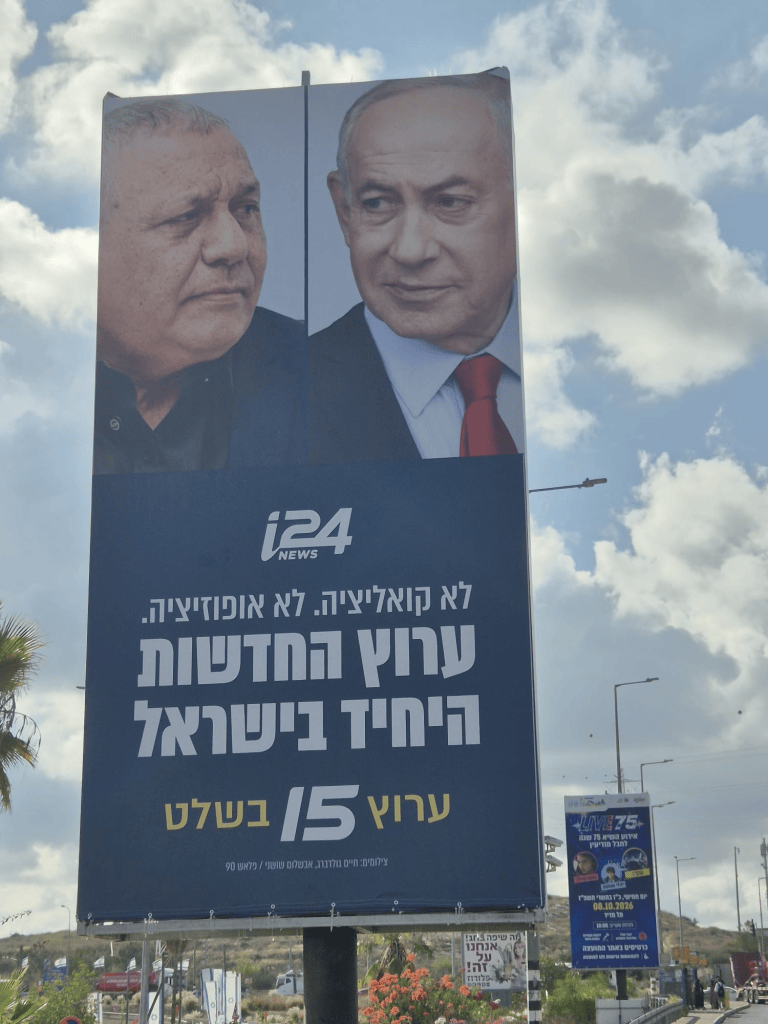
Evidence that Netanyahu had long been working on building the new coalition can be found in the billboards of Channel 15 – the old i24 channel – now hanging in the streets: Netanyahu and Eisenkot side by side, under the slogan “Not coalition. Not opposition. The only news channel in Israel.” In an age of lost innocence, billboards like these in election season raise the question of whether there is something here beyond branding.
Given the absolute importance Netanyahu attaches to branding, and his special relationship with the channel’s owner, Patrick Drahi, the question arises: if Channel 14 was meant to serve the old era of Likud, Kahanists and ultra-Orthodox, is Channel 15 meant to serve the new era of Bibi and Eisenkot? The president’s intervention in the process of forming the next government points in the same direction.
The Clash with Ronen Bar
And here lies the great disruption in Netanyahu’s campaign. The revelations about the warnings, and the failure of his talks in the Gulf to extract a statement of denial from the Emirati ruler Mohammed bin Zayed, led him to open a noisy front against the former head of the Shin Bet, Ronen Bar – and in doing so he closed the door on a coalition with Eisenkot.
The difference between Naftali Bennett and Avigdor Lieberman on the one hand and Eisenkot on the other was that the first two said clearly and without blinking that they would not sit under Netanyahu, whereas Eisenkot attacked Netanyahu but, on the question of whether he would sit with him, kept going round in circles.
The disruption in Netanyahu’s campaign: the revelations about the warnings he received, and his failure to extract a denial from bin Zayed, led him to open a noisy front against Ronen Bar – and in doing so he closed the door on a coalition with Eisenkot.
In July, when Dana Weiss asked Eisenkot on Channel 12 News whether he would say explicitly that he would not sit with Netanyahu, he dodged, and confined himself to stating that Netanyahu and the members of his cabinet are unfit for any leadership role. The revelations about the warnings hardened his statements, but even then he did not say explicitly, in the manner of Lieberman and Bennett, that he would not sit in the same government as Netanyahu.
Only after the direct front between Netanyahu and Ronen Bar had opened did Eisenkot issue the statement that comes closest to ruling out a joint government. Still not “I will not sit with Netanyahu,” but: “Netanyahu has lost it. Every minute he remains in office is dangerous to the citizens of Israel and to Israeli society.” After a statement like that, it is clear that sitting with the man is no longer an option. So, at least, one must hope.
Is this what lies behind the about-turns of the head of the Shin Bet, David Zini, on the question of Eisenkot’s security detail? Having already approved protection for him, the Shin Bet backtracked and refused it.
Cancelling the Election
Netanyahu’s historic bloc is falling apart, the bloc he had been slowly advancing has run into a dead end, and what is left to him is to create a situation in which the election is cancelled. That is the possible immediate context of the warning he sounded, that “ahead of the election our enemies will try to attack us.”
A question of logic arises: if “our enemies” want a “Muslim Brotherhood” government to arise in Israel that will establish a Palestinian state, why would they now want to disrupt the election and leave Netanyahu in power? But in the new era, logic is not Israel’s strong suit.
Only after the direct front between Netanyahu and Ronen Bar had opened did Eisenkot issue the statement that comes closest to ruling out a joint government. Still not “I will not sit with Netanyahu,” but: “Netanyahu has lost it. Every minute he remains in office is dangerous to the citizens of Israel.”
And if Eisenkot indeed can no longer sit in a government with Netanyahu, this obliges the “change bloc” to change course toward the Arab parties. At present the bloc is distancing itself from partnership with the Arabs in order to discourage the Arab voter, so that he will not flock to the polls and become a decisive force in the formation of an “anyone but Bibi” government – a policy that would have paved the way to a Netanyahu-Eisenkot government.
But the interest now is precisely a massive Arab turnout on election day, which would wipe out all the small parties Netanyahu set up in order to force a Netanyahu-Eisenkot government.

