

The Speech That Really Mattered Was Abu Mazen’s Recorded Address to the UN
Source: Zman Yisrael (Israel Time)
By Pinhas Inbari
Prime Minister Benjamin Netanyahu provokes the nations of the world and gambles on the American veto. Abu Mazen, in a recorded speech, dropped the 1967 borders and pushed Jerusalem and the right of return to the margins. Which of them is reading the map correctly?
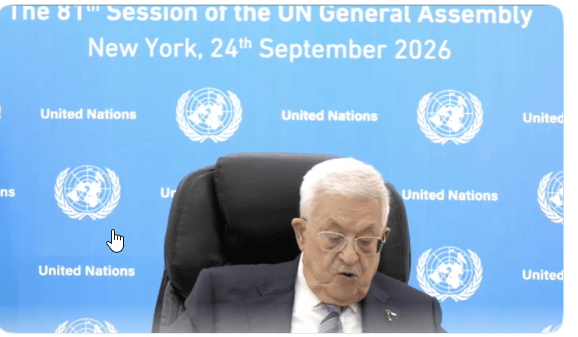
While Israel was riveted by Netanyahu’s polished speech at the UN General Assembly, the more important speech was delivered, by recording, by Palestinian Authority President Abu Mazen (Mahmoud Abbas). For the first time in his UN speeches, and indeed anywhere, he omitted the fixed mantra of the 1967 borders as the borders of the Palestinian state. Jerusalem as the capital of Palestine and the right of return he slipped in only toward the end of the speech, as if merely fulfilling an obligation.
Does this hint at what is happening behind the scenes of the international contacts on the Palestinian issue? In any case, it is consistent with what we have heard from sources close to Abu Mazen: there is regret that in past talks with Israel the Palestinians were rigid, and that this was, to a large extent, why agreements were not reached when they were within reach. Now, as they await the results of the Israeli elections, a new Palestinian approach may be taking shape, encouraged by the Arab states.
Sources close to Abu Mazen express regret over Palestinian rigidity in past talks with Israel, which is also why agreements were not reached. Now, awaiting the results of Israel’s elections, a new Palestinian approach may be taking shape, encouraged by the Arab states.
Netanyahu’s Sparta
But before going into detail, a remark on Netanyahu’s fluent speech. He defended an Israel that he himself is destroying: just, democratic, moral, defending Western values against “the barbarians.” In other words, Netanyahu knows very well that the Israel he describes barely exists anymore, yet it is that Israel that will defend us. Is the campaign above all else? He described Athens, but he is building Sparta.
Athens will defend us; Sparta will destroy us.
The sight of delegates walking out of the hall as he took the podium, and of Netanyahu insulting them as they left, should worry every citizen. Israel was born of a General Assembly resolution, and so far the American veto has prevented the imposition of lethal sanctions on it. But the veto is not guaranteed.
In December 2016 the Barack Obama administration refrained from casting a veto, and Resolution 2334 against the settlements passed the Security Council. An American president who gives up on Netanyahu’s Israel could repeat this, and this time not only on the settlements.
Turning the UN General Assembly into a Channel 14–style cheering studio could bring that day closer. Even without it, “antisemitic” Britain is close to sanctions of its own, and provoking the nations of the world pushes Israel into the corner once occupied by apartheid South Africa, or into Netanyahu’s Sparta, or onto Masada.
He defended an Israel that he himself is destroying: just, democratic, moral, defending Western values against “the barbarians.” Netanyahu knows very well that the Israel he describes barely exists anymore. He described Athens, but he is building Sparta.
Cursing as policy is nothing new. Yair Netanyahu cursed French President Emmanuel Macron in crude terms, Britain has been branded “antisemitic,” and so on.
For now, the world still distinguishes between Israel and Netanyahu. But if in a month’s time Israelis elect him again, the partition will disappear. Israel will be Netanyahu, and Netanyahu will be Israel – in Miami?
What Abu Mazen Did Not Say
And this brings us to Abu Mazen. What he did not say is no less important than what he did say. The formula “a Palestinian state on the 1967 borders” vanished, and in its place he spoke of a two-state solution “on the basis of international legitimacy.” He mentioned East Jerusalem several times without the title “our eternal capital,” and only in the concluding paragraph did “a state whose capital is East Jerusalem” appear.
Is an inter-Arab consensus forming on Jerusalem, one in which the PLO is fighting for its place? In 2018 he rejected, from the UN podium, the idea of a capital in Abu Dis. Is the idea coming back?
The right of return was also pushed to the margins. Abu Mazen wore the “key of return” pin, spoke at length about the Nakba and defended UNRWA, yet precisely there the return of the refugees was absent. It was slipped in once at the end, as a ceremonial formula: “in accordance with Resolution 194.”
What Abu Mazen did not say is no less important than what he said. The formula “a Palestinian state on the 1967 borders” vanished, replaced by a two-state solution “on the basis of international legitimacy.” East Jerusalem was mentioned without the title “our eternal capital.”
In practice, the refugee camps are already gone: in Syria the war destroyed them; in Gaza we saw what happened to them; in the northern West Bank Israel demolished the Jenin, Tulkarm and Nur Shams camps; and in Lebanon President Joseph Aoun demanded that they be disarmed, and Abu Mazen agreed. The demand to restore UNRWA’s standing will not materialize, because it contradicts the regional recognition that the right of return, in its original meaning, has reached its end.
A Demilitarized State, Penalties for Settlers
Abu Mazen said that only the Palestinians will decide their future, but also that peace will open the way to regional integration. In other words, the settlement will be folded into the anticipated normalization between Israel and Saudi Arabia, and Abu Mazen demands that his position be taken into account – not as happened with the “day after” in Gaza.
But the opposite is happening. Borders, Jerusalem and refugees were the permanent-status issues between Israel and the Palestinians. In Gaza, these issues are being taken out of direct talks between Israel and the PLO and transferred to the Board of Peace. Are they also being transferred to an international solution in the West Bank? A day before the speech, Avigdor Liberman proposed that Jordan assume responsibility for Areas A and B. Does he know something we don’t?
Abu Mazen also distinguished between Israel and its government. He demanded penalties for settlers and international protection from the settlers – not from Israel, and not even from “the occupation,” a code word for Israel. He even praised Britain and the 12 countries that have banned imports of settlement products. And most important of all: he wants a state that is “unarmed, living in security and peace alongside the State of Israel.” Those who frighten us with a “PLO army that will turn its guns on us” will have to find another threat.
Abu Mazen distinguished between Israel and its government, demanding penalties for settlers and international protection from them – not from Israel. He wants a state that is “unarmed, living in security and peace alongside Israel,” which undercuts the scare of a “PLO army that will turn its guns on us.”
In contrast to Netanyahu, who for the first time in years did not mention the Abraham Accords in his speech and ignored President Donald Trump’s plan for Gaza, Abu Mazen supported that plan and the Board of Peace’s plans for Gaza, on condition that they be linked to a solution in the West Bank and East Jerusalem. He also claimed that he has fulfilled the reform requirements, and that the $6 billion Israel is withholding should therefore be released.
Abu Mazen’s claim to have fulfilled the reform requirements deserves an asterisk. The donor countries were not convinced; they explained the emergency aid they gave the Authority by the stranglehold Minister Bezalel Smotrich has placed on the PA’s budget, not because they were persuaded by the reforms.
Particularly jarring is his claim of curriculum reform “in cooperation with UNESCO.” UNESCO’s involvement began only in April; the PA’s textbooks have not yet changed, and they do not meet the donor countries’ standards of education for peace. In last year’s speech he himself promised to bring them into line with UNESCO standards within two years, but the process has barely begun, and it cannot be regarded as a “completed reform.”
After the Elections, We Will Know
While Netanyahu drives the world’s delegates out of the General Assembly hall, insulting them as he does so, Abu Mazen speaks the language the world wants to hear. If a new Palestinian approach is indeed taking shape behind the scenes, we will know after the Israeli elections. If not, it will turn out that the speech was written mainly for the donors who want reform and elections. Were the speech and the elections meant to serve the same purpose – to make the Authority relevant?
While Netanyahu drives the world’s delegates out of the General Assembly, insulting them as he does so, Abu Mazen speaks the language the world wants to hear. If a new Palestinian approach is indeed taking shape behind the scenes, we will know after the Israeli elections.
Our sad irony is that Abu Mazen seeks to be relevant, while we are giving up our own relevance. And in this interim period we and the Palestinians share the same status: both we and they are irrelevant.
Pinhas Inbari is a senior Middle East researcher, journalist, author, screenwriter and poet. He wrote the entries on the Palestinians in the New Hebrew Encyclopedia and served for many years as a researcher at the Jerusalem Center for Public Affairs. He has written non-fiction books on the Palestinian problem and a linguistics book on the roots of the Hebrew language, “Sipur Shoresh” (The Story of a Root). The novels he co-wrote with his wife, Aviva, are “Al Gav Sufa” (On the Back of a Storm), about the challenges facing the Christian communities of the Western Galilee under the British Mandate in the face of radical Islam and the status of women, and “Shomer HaShe’ol” (Guardian of Sheol), which deals with Israeli corruption.

