

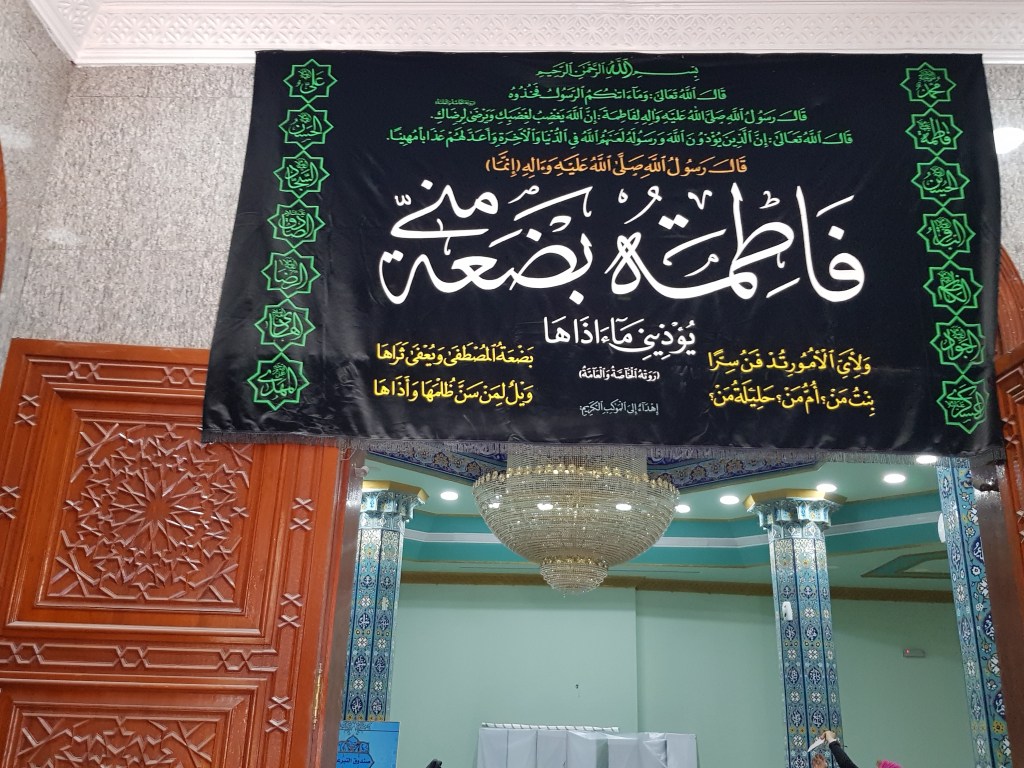
Photograph: Pinhas Inbari. The "Fatima" sign at the Shiite mosque in Dubai.
By Pinhas Inbari | Israel Time
In the end, there will be a "beautiful" deal between the United States and Iran—or there won't be. The question of whether it will be good or bad does not depend on the agreement itself, but on what follows: whether its purpose is to preserve a "listening post" in Tehran for Washington to maintain talks, or to return to the original intent of overthrowing the ayatollah regime and closing the chapter on the Khomeinist revolution. In other words: should the U.S. keep Iran unified, hoping to pry it away from the Russia-China axis and deliver it to the American side? Or should it partition Iran along sectarian lines?
An Inconvenient Partnership
What few realize is that an intimate partnership existed between Khomeinist Iran and the United States—in both Afghanistan and Iraq—until the CIA fantasized about Iran as America's principal ally instead of Israel.
Cooperation began in Afghanistan. Iran surprised Washington and extended a hand against the Taliban. Then came the shock in Iraq, where Iran and America coordinated operations against al-Qaeda. When Iraqi Kurds declared independence aspirations, they were stunned to discover American advisers embedded in the Shiite militias tasked with crushing their rebellion. Iraqi Prime Minister Nuri al-Maliki, the pro-Iranian puppet, was the fruit of an Iran-U.S. understanding—and he served both masters faithfully.
The paradox was striking: at the level of slogans and Al-Quds Day processions, America was "the Great Satan." But in the operational reality of Afghanistan and Iraq, Iran and America were coordinated down to the tactical level.
The Russia Connection: Chechnya
The cornerstone of the Iran-Russia relationship, by contrast, was precisely the assistance Iran provided to Vladimir Putin in suppressing the Chechen rebellion. Not direct involvement, but behind-the-scenes work—particularly in calming Russia's Islamic republics so they would not be drawn to support Chechen insurgents. Like in Afghanistan, Iran sought allies against radical Sunni jihadists. In Afghanistan it was America; in Chechnya it was Russia.
Why the Gulf Is Alarmed
This history explains why Gulf states, monitoring U.S.-Iran talks, fear that ultimately Iran will pull America back toward a course of strategic cooperation against the Sunnis. That is the central anxiety. And with President Trump, a man who has never shied from paradigm shifts, it could happen.
This is precisely why Saudi Arabia, the Gulf emirates, and Israel share a common goal: overthrowing the ayatollah regime. Any solution that leaves them in power is unacceptable. The Saudi logic is stark: Riyadh does not bet on a "pragmatic ayatollah" regime. From its perspective, the ayatollahs should simply disappear.
Israel's Untapped Role
And here is where Riyadh needs Israel. But how? Propaganda in Farsi on social media will not topple the regime. What might work—though desperately late—is finally doing what we should have done during the Syrian civil war and failed to do: connect with Iran's minorities and dismantle the Khomeinist revolution from within. Israel has untapped capacity to aid two key minorities capable of driving that dismantling: the Kurds and the Ahwazi Arabs.
The Kurds present a trust problem. Our indifference to their plight in Syria has left a scar. Iraqi Kurds have bitter experience with the U.S.; without genuine guarantees against betrayal, they prefer Turkey's relatively good terms. But the Turkish context is precisely what makes them critical to us. It is no secret that Erdoğan harbors enmity toward Israel, and assessments of an Israeli-Turkish conflict grow. We must persuade the Kurds to join the effort against the ayatollahs—partly to complicate Erdoğan's Kurdish flank. With Kurds in Syria and Iraq it is difficult; with those inside Iran, untested, the odds are better. We have not yet betrayed Iran's Kurds.
The Ahwazi Card
Khuzestan—Ahwazi Arabs—holds far greater potential. This Arab-majority province overlooks the Strait of Hormuz and houses Iran's oil industry. Without it, the ayatollahs cannot fund Iran itself or export Khomeinism. Khuzestan also defines the very nature of the Gulf: Arab or Persian.
Iran insists on calling it the "Persian Gulf." The rift with Khalid Mashal began when he said "Arab Gulf." That obsession with nomenclature is not semantic; it reflects Iran's intent to impose Shiite hegemony over the Gulf emirates—and it does not hide the fact.
A case: the Shiite mosque in Dubai's old souk. A large placard reminds Sunnis of Karbala—Shiism's foundational massacre and eternal catalyst for revenge. It evokes Fatima, daughter of the Prophet, mythological mother of the Shiite Imams. Though she died before Karbala, tradition says she mourns in heaven for her descendants slaughtered there. She is "mother of the martyrs," her grief the Shiite parallel to Mary's "Pieta."
Planting that sign in the faces of Sunnis in Dubai's central market is a declaration of war. The UAE has shown restraint. But the hour has come to aid their Arab brethren in Khuzestan. Once the Ahwazis free themselves from the ayatollahs, the Gulf becomes Arab on both coasts—transforming the entire strategic equation of the Middle East.
The Israel Question
There is a real convergence of interests between Israel and the Arabs in toppling the ayatollahs. But the ayatollahs will not fall to slogans or propaganda. They will fall to hard work—the work we should have begun long ago. Better late than never.
Of course, Israel of Ben Gvir and Smotrich—Saudi Arabia will not draw near it, especially not after the stunts in Ashkelon and on the Temple Mount. All of this will have to wait until after elections, God willing soon.

