

ANALYSIS | RAMALLAH & JERUSALEM
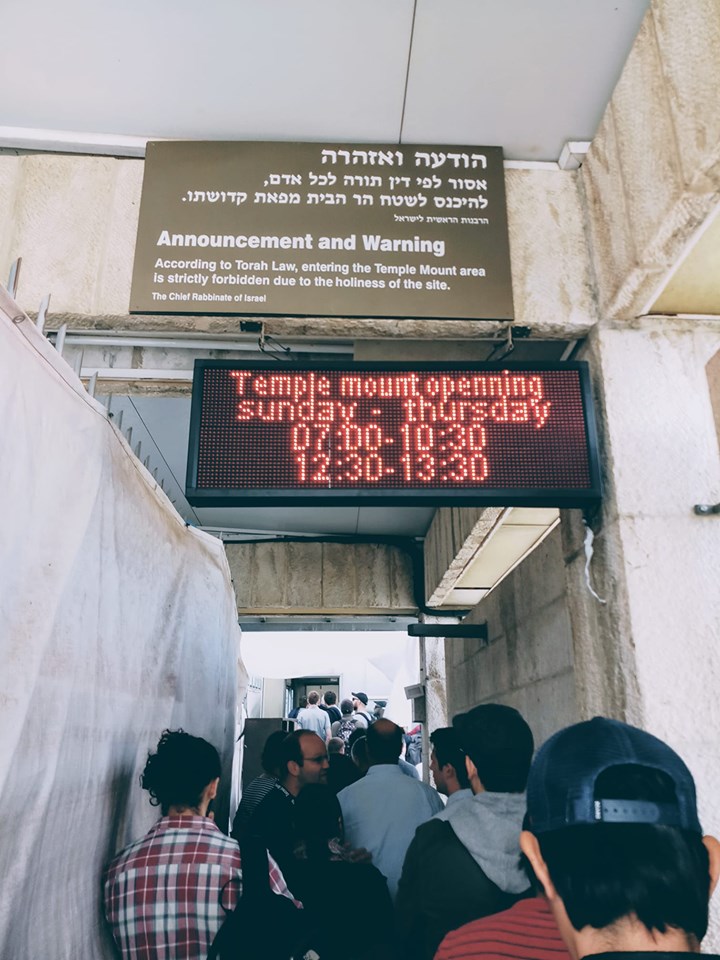
While Itamar Ben-Gvir and MK Yitzhak Kroizer hoist Israeli flags opposite the Dome of the Rock, the Eighth Fatah Conference convenes in Ramallah in an atmosphere of crown-inheritance. Abu Mazen's strategy against Jewish terror on the Mount is barely concealed: be patient, the Jews will do the work for us.
By Pinhas Inbari
Originally published in Hebrew in Zman Yisrael (Israel Time)
* * *
Over the weekend, two events converged on a single day, heralding a head-on collision: a rampaging Jerusalem Day on one side, and the Eighth Fatah Conference in Ramallah — convening ten years late — on the other.
Jerusalem Day: From the Western Wall to the Mount
Jerusalem Day, which was meant to mark the city's unity and serve as a national holiday, has long since become an ugly nationalist revelry of uneducated youth from the Religious Zionist camp — the urban twin of the unkempt "hilltop youth" with their flying tzitzit roaming the West Bank.
Jerusalem Day, which was meant to mark the city's unity and serve as a national holiday, has long since become an ugly nationalist revelry of uneducated youth from the Religious Zionist camp — the twin of the hilltop youth with their flying tzitzit roaming the West Bank.
This is nothing new. What is new this year — and herein lies the seed of disaster — is that whereas in previous years the focal point was the Western Wall, this year, although the Wall tradition was preserved, the center of gravity shifted to the Temple Mount.
At Temple Mount activist websites, the Western Wall events were entirely ignored: in their view, the Wall has no halakhic significance whatsoever. Prayer at the Wall, they hold, is a substitute for the sacred — and once the Temple is rebuilt, prayer at the Wall will be abolished. In fact, these circles argue, the Wall should be bypassed already now, so that one's entire face is turned inward toward the Temple, on the Mount itself.
At the same time, a new "biblical" form of worship has been invented — prostration on the floor of the Temple Mount — designed to distinguish it from prayer at the Wall and to circumvent the prohibition on prayer atop the Mount under the status-quo arrangements (which Israel is, in any case, already violating). But if we are going to invoke scripture: Jacob prostrated himself on the ground before Esau — which would mean that the Jews on the Al-Aqsa plaza ought to be prostrating themselves before the Muslims.
"And he himself passed before them, and bowed himself to the ground seven times…" (Jacob bowing before Esau, Genesis 33:3)
An Israeli Flag Opposite the Dome of the Rock
Following the Red Heifer affair and the dispensation granted by Rabbi Dov Lior to National Security Minister Itamar Ben-Gvir to enter Al-Aqsa, Ben-Gvir himself appeared opposite the Dome of the Rock on Jerusalem Day — clutching a giant Israeli flag. An unprecedented step inside the Temple Mount compound.
Following the Red Heifer affair and Rabbi Dov Lior's dispensation to Ben-Gvir to enter Al-Aqsa, Ben-Gvir himself appeared opposite the Dome of the Rock on Jerusalem Day, clutching a giant Israeli flag — an unprecedented step inside the Temple Mount compound.
His Otzma Yehudit faction colleague, MK Yitzhak Kroizer, who ascended with him, simultaneously posted on X:
"The time has come to remove the mosques and to act for the rebuilding of the Temple! Happy Jerusalem Day."
Ben-Gvir, for his part, declared from the Mount:
"We have restored governance and deterrence in Jerusalem and throughout the State of Israel. The Temple Mount is in our hands."
Already circulating on messianist websites is an image linking the messianic patch that has appeared in the IDF to the wars Israel is fighting on every front, with the message unmistakable: these are the wars of the Temple and the Temple Mount.
In Ramallah: A Crown to Inherit
On the other side — the Eighth Fatah Conference in Ramallah. The conference's first act was to elect Abu Mazen as chairman of the movement, and corridor whispers now have it that his son Yasser is to be appointed his deputy. According to sources inside the conference, tempers are running high over Abu Mazen's move; in their words, he "wants to turn Fatah into a monarchy, in which the father bequeaths his crown to his son" — in flat contradiction to the revolutionary character of the movement.
Instead of grappling with the fate of the Palestinian people, those same sources say, Fatah's representatives are immersed in the distribution of posts and honors. From above, Abu Mazen is reshaping the leadership — and not for the better — so that it will represent the interests of the family, headed by his son Yasser. "A great deal of money is passing from pocket to pocket," the sources say. Translation: against the backdrop of the Authority's financial crisis, considerable sums of unknown provenance are greasing the selection of the figures Abu Mazen favors.
On the other side — the Eighth Fatah Conference in Ramallah. The first move was Abu Mazen's election as chairman; now rumors of his son Yasser's appointment as deputy are sweeping the corridors. According to sources inside the conference, tempers are running high.
This ought to alarm Hussein al-Sheikh, who had until now been earmarked as Abu Mazen's heir. Surprisingly, he is utterly indifferent, saying that in any event the next president will be chosen by election, and there is no point in expending energy on "as-if" elections.
A Ramallah-Only Show
Although the conference planners sought to give it the appearance of "unity" with Gaza and of broad participation by the Fatah diaspora — for which purpose they installed large videoconference screens — it was, in the end, a Ramallah-only show. Participants outside Ramallah merely listened; they did not speak.
As for Gaza: the conference was held under Hamas auspices. True, there were Fatah-tagged stewards present — but their badges were styled differently from those in Ramallah, and a Hamas representative sat in the hall, visible on the screens in Ramallah.
As for Beirut, which is supposed to be the capital of the refugees — it sat in silence. And on this matter one must attend carefully to what Abu Mazen said in his speech: he reiterated the insistence on the right of return, but when he descended into the details, he reported that he is in talks with the Lebanese government on disarming the PLO and on regularizing the status of the refugees within Lebanon. That is: registering their property, and perhaps even permitting them to work and study in Lebanon — both of which are currently forbidden to them.
Bottom line: this is the de facto liquidation of the refugee condition and the gradual integration of the refugees into the Lebanese fabric. Content radically different from the wrapping of the "right of return."
One should also note the absence of any delegation from Jordan — not even on the videoconference screens. The Jordanian government had notified Fatah that any Jordanian who took part in the conference would have his Jordanian citizenship stripped immediately. Of Syria there is nothing to say: all the refugee camps were destroyed by Bashar al-Assad, Ahmed al-Shara' is not willing to rebuild them, and no sane refugee will return to Syria.
Although the planners sought to give the conference the appearance of "unity" with Gaza and broad diaspora participation, it was a Ramallah-only show. Participants outside Ramallah merely listened — they did not speak.
The Pressures Beneath the Speech
In Abu Mazen's speech one could detect echoes of the pressures Western states are exerting on him. First — elections. He claimed to be moving toward elections to all PLO institutions; but at a meeting held a few days earlier in Nablus, between the German envoy in Ramallah and Abu Mazen's deputy in Fatah, Mahmoud al-Aloul, the German representative said — according to Nablus sources — that there is no substitute for general elections, and that the European Union will accept no alternative.
A further pressure concerns the rewriting of the Authority's incitement-laden school curricula. Abu Mazen said they had turned to UNESCO to prepare an alternative curriculum. What he did not say is that the meetings scheduled with UNESCO never took place.
But his most interesting remark was this: he is prepared to cancel the unilateral measures against Israel — provided Israel cancels its own unilateral measures. In other words: he is being pressed to withdraw the case against Prime Minister Benjamin Netanyahu in The Hague, and to influence South Africa to follow suit. His answer: Netanyahu must first cancel Bezalel Smotrich's "Decisive Plan."
The Strategy: Sit Tight
And it is precisely the Hague case that points to the path Abu Mazen is likely to take. In the face of the Al-Aqsa Martyrs' Brigades' demands to renew the terror campaign, he prefers to cling to the diplomatic war: Israel's isolation in the world, European sanctions on Israel, and — who knows — perhaps even American sanctions under the next administration. From this angle, Jewish terror and the assault on the Temple Mount serve his purposes with surgical precision.
Against the demand to renew terror, Abu Mazen clings to the diplomatic war: isolating Israel, European sanctions, perhaps American sanctions under the next administration. Jewish terror and the assault on the Temple Mount serve his purposes with surgical precision.
So beyond the scramble for posts and honors — what, in fact, is Fatah's strategy in the face of the present challenges? Against Jewish terror, and against the declarations of the destruction of Al-Aqsa and the rebuilding of the Temple?
In his speech, Abu Mazen dropped a barely concealed hint.
Nothing. Be patient. The Jews are destroying themselves. We shall sit quietly — and they will do the work for us.
Pinhas Inbari is a senior Middle East analyst, journalist, author, screenwriter and poet. He is the author of the entries on the Palestinians in the New Hebrew Encyclopedia and served for many years as a researcher at the Jerusalem Center for Public Affairs. He has written nonfiction works on the Palestinian problem, as well as a linguistic study of the roots of the Hebrew language, Sippur Shoresh ("Root Story"). Together with his wife Aviva, he co-authored the novels Al Gav Sufa ("On the Back of a Storm"), on the trials of the Christian communities of the Western Galilee under the British Mandate, facing radical Islam and the status of women; and Shomer ha-She'ol ("The Keeper of the Underworld"), which deals with Israeli corruption.

