

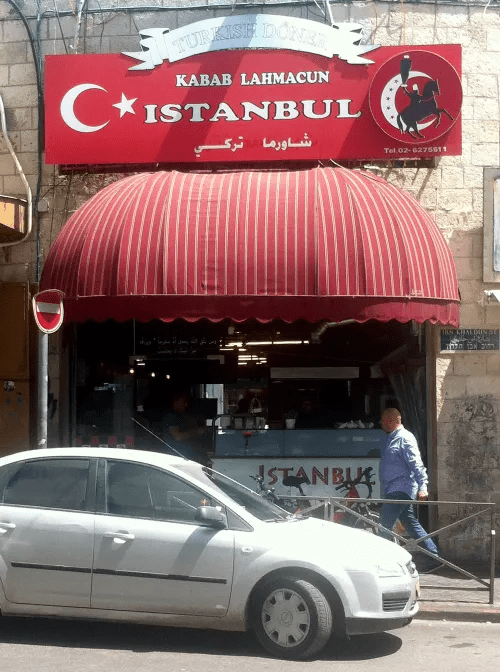
Turkey in Jerusalem. Photo: Pinhas Inbari
Israel needs to reckon with two troubling realities: Hamas is not going anywhere, and Turkey is entrenching itself in Gaza. This is the Turkey that has become patron of a new ISIS in Syria — and the question must be asked: will it upgrade Hamas into ISIS? At this stage, we confine ourselves to framing the challenge, not to explaining how it came about.
First, what does this mean for Gaza itself — a society in trauma. Will it shift from the atmosphere of Hamas-style jihad to that of al-Qaeda-style jihad? A telling sign can be found in the reconstruction of Gaza's mosques: one of the three mosques already rebuilt bears the name of Abdullah Azzam, the figure from the Jenin area who served as Osama bin Laden's mentor in Afghanistan/Pakistan. The reconstruction Turkey style if of mosques- not of houses.
The injection of an ISIS-like spirit into Gaza dovetails with the reconstitution of ISIS in Syria — this time under Turkish leadership. Whereas the original ISIS kept its distance from targeting Israel, the new ISIS will actively "seek out" Israel.
Against this backdrop, the struggle for Hamas leadership between Khalil Hayya and Khaled Meshaal must also be understood. Hayya is a leader rooted in Gaza, and his top priority is Gaza's reconstruction. Meshaal, by contrast, is from the West Bank — like Abdullah Azzam — and is closely aligned with Turkey and Syrian President Ahmad al-Sharaa. He would prefer to emphasize Hamas's jihadist role and steer the movement toward ISIS.
It is this tension that explains why the original date for Hamas leadership elections was postponed — the fundamental question being whether the movement's direction lies in rebuilding the Strip, or in exploiting the pain and trauma of Gaza's population to radicalize it along ISIS lines.
Israel itself is contributing to this ISIS-style radicalization. On the very first day of Ramadan, certain Jewish individuals chose that occasion to stage provocations on the Temple Mount. More broadly, the stated objective of the new ISIS — unlike the original — is to "liberate" the Al-Aqsa Mosque, thereby echoing the messaging of Turkish President Erdoğan. Israel is constructing the very platform from which a declaration of jihad against it can be launched, as though no lesson has been learned from the provocations on "Jerusalem Day" and the violations of the status quo on the Temple Mount that drove Hamas to October massacre.
To understand how Turkey exploits the perceived Jewish threat to Al-Aqsa Mosque, one must look back to an international imams' conference held in Istanbul in 2017, where a presentation was shown depicting how the Temple threatens the mosques. In other words, Turkey is attempting to mobilize the entire Muslim world against Israel under the banner of "Liberating Al-Aqsa."
Is Israel sleepwalking — in the manner of a Greek tragedy — into a war with Islam led by Turkey and the new ISIS?
Not necessarily. Turkey does not only threaten Israel — it also threatens all of Israel's potential partners, including Jordan, Egypt, the UAE, and Saudi Arabia.
As for Jordan: the Hashemite family helped bring down the Ottoman Caliphate — the very caliphate Erdoğan seeks to restore. He has historical scores to settle with the Jordanian royal house. King Abdullah knows this, and hastened to Istanbul to embrace Erdoğan, lacking the Israeli backing he once relied upon. The perceived Jewish threat to Al-Aqsa enables the Hashemite king to offer an alliance to the sultan, but the mounting threat posed by Khaled Meshaal from Syria leaves Jordan with no room for illusions. It is tightening measures against the Muslim Brotherhood in Jordan and cooperating with U.S. forces against reconstituting ISIS cells in southern Syria. The question of how long the United States will remain in Syria weighs on Jordan as well.
As for the UAE: some of the rifts that have opened between it and Saudi Arabia also relate to this question. When Israel shows no interest in the alliance with the desert power that was on the table, Saudi Arabia casts glances toward Turkey — though one should assess these as tactical maneuvers rather than the real thing. The test will come if Saudi Arabia agrees to Erdoğan's proposal to form a trilateral alliance with Pakistan, and if it agrees to purchase Turkish weapons. As long as that does not happen, nothing concrete is happening, and "it is all talk." Meanwhile, the UAE — which is not prepared to hear anything about Turkey or Qatar — is distancing itself from Mohammed bin Salman.
It should be assessed that no Turkish army will come to Gaza. Nor does it need to — perhaps Turkmen soldiers from the Balkans will come instead. But what Turkey truly wants is a port. That would represent an enormous defeat for the UAE, which together with Greece and Cyprus formed the Eastern Mediterranean energy alliance, with Israel serving as the binding link.
Is that link still in place?
 פנחס ענברי - מזרח תיכון מסובך במילים פשוטות