

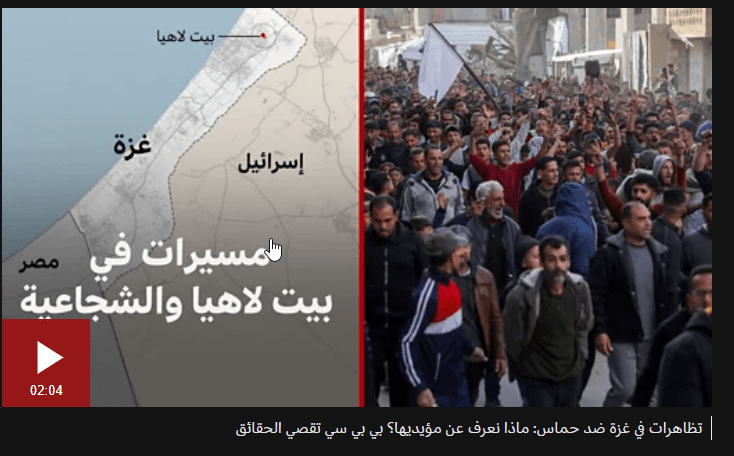
The popular uprising against Hamas in Gaza should not come as a surprise. From my knowledge of what happened in Syria, opposition to Assad's murderous regime led to seeking contact with Israel. Similarly, Hamas's brutal tyranny has generated resistance to the Islamist terrorist organization, with potential for extending a hand to Israel.
Hamas was aware of the burning ground beneath its feet. We saw this during the humiliating ceremonies of hostage releases, when many terrorists attached handcuffs to their chests—a clear message to Gazans themselves: be careful.
Things developed far beyond warnings. There is chilling evidence of Hamas members shooting at Gazans who sought food outside the distribution framework of Hamas and UNRWA, torturing suspects of contact with Israel, and simply demonstrating "governance."
The message from the insurgents is simple: "For the sake of Allah—Hamas, out! Out!" and an immediate end to the war.
This uprising has no leadership—a sign that it is truly authentic, with potential for real change in Gaza by removing Hamas rule. At this moment, there is no alternative presented, but if the phenomenon is not suppressed by Hamas, leadership emerging from within might extend a hand of peace to Israel.
There were reports that Hamas would organize demonstrations supporting itself after Ramadan prayers, but this did not happen. Has Hamas lost the ability to organize them, or did Khalil Hayya instruct his people to avoid it? It's too early to tell.
That Hamas is unhappy with these developments is clear, but the Palestinian Authority is not enthusiastic either—and neither is the Israel of Ben Gvir and Smotrich.
Just as Israel rejected Syria's extended hand, there is concern the same will happen in Gaza—if indeed a leadership emerges that accepts Israel's conditions to end the war, Israel will reject the extended hand. We already see signs that the entity helping Hamas overcome demonstrations against it is Israel itself, by intensifying the pace of attacks in Gaza as if to deny insurgents the time needed to coalesce into an organized force. Moreover, when examining the identities of those eliminated by Israel, it's hard not to feel that many belong to Hamas's bureaucracy, not necessarily to terrorist cadres. The apparent peak seems to be the elimination of Hamas's new spokesperson in Gaza, Abd al-Latif Qanou.
Why? The impression is that following the Khalil al-Hayya and Bohler proposal, Israel has set a goal to eliminate in Gaza those who might be "Hayya's people" who would establish the civilian mechanism to replace military Hamas. What characterized Qanou compared to Abu Obeida was that he spoke openly in civilian clothing in "administrative" language, unlike the military spokesman, Abu Obeida, who appeared masked like a terrorist and communicated military matters in the language of terror and threats. The elimination of the "civilian" Qanou seemingly indicates that Israel prefers the terrorist Abu Obeida over Qanou.
Ostensibly, the demands of the insurgents align with the war's objectives—dismantling Hamas's military capabilities, and their additional demand to immediately end the war enables the realization of the second war objective—releasing the hostages.
But dismantling Hamas's military capabilities and returning the hostages are spin goals covering the real, undeclared objectives of this government—transfer of Gazans, military rule while renewing settlements. Regarding East Jerusalem—a synagogue for Ben Gvir's rabbis on the Temple Mount, and Smotrich's decisive plan for the West Bank.
Accepting an extended hand from Gaza—which has not yet been extended—eliminates the entire vengeance narrative important for the current government to develop in building the new IDF of "brave lions," where "all Gazans are Hamas," and all should be expelled.
Surprisingly, official Ramallah is also indifferent to what's happening in Gaza. Furthermore, an initiative by Ramallah's Fatah to hold a demonstration supporting the insurgents in Gaza was thwarted by the Muqata'a. The messaging from Ramallah's spokespeople talked about "Hamas as a failed idea," not that the idea of muqawama (resistance) failed—an idea that has already destroyed Syria and Iraq, and now Gaza. But in the Muqata'a's messaging, there is no word of encouragement for the insurgents in Gaza; on the contrary, there is a tone of rebuke for not "blaming Israel."
Fatah and PA websites also ignore these developments. The reason is that the Fatah organization is also one of "struggle." The dispute with Hamas is about "who guides" the struggle and what its characteristics are, not the idea itself.
Second, the insurgents do not demand the Authority's return to Gaza, meaning: the emergence of authentic leadership for Gaza, outside the framework of "fighting organizations," threatens the idea of Fatah as well, and the end of the PLO chapter in Palestinian history alongside the Hamas chapter.
The potential, as yet unrealized, for a new, authentic leadership in Gaza contains the seed for implementing the Bohler-Hayya proposal, as such leadership would be interested no less than Israel (the state, not the government) in disarming Hamas, which according to the Hayya-Bohler proposal, an Arab/international force would enter the tunnels to collect Hamas's weapons.
This also opens the door to replacing Qatar with the Emirates as the influential Arab force in Gaza, along with Indonesia, which could bring its Islamic curriculum that opposes jihad.
In short, a window has opened for us to end the war with a true, complete victory. The true State of Israel would widen this opening. The government of Israel will close it—there is reason to fear.
 פנחס ענברי - מזרח תיכון מסובך במילים פשוטות