

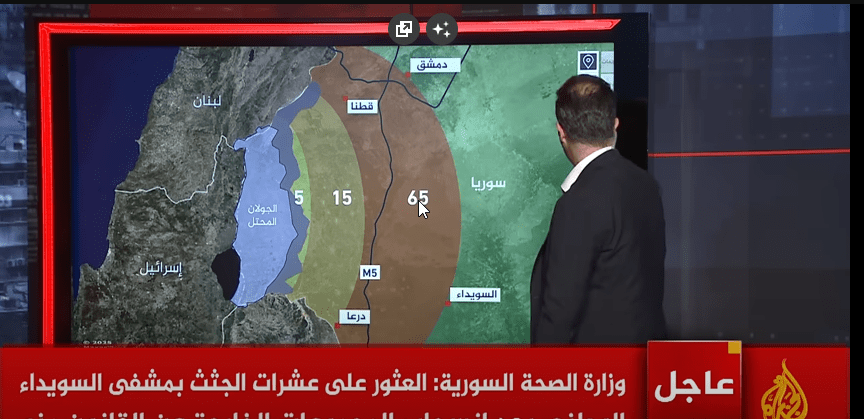
The jihadist attack on the Druze in Sweida has prematurely exposed Israel's strategic error in prioritizing agreements with Jolani over peace with Saudi Arabia.
The Israeli government's calculations are clear: Saudi Arabia demands "tangible progress" on the Palestinian issue and is unwilling to approach Israel as long as Ben-Gvir and Smotrich remain in the government. This is in addition to Saudi Arabia's lack of trust in Prime Minister Benjamin Netanyahu personally. Meanwhile, Jolani has no demands regarding the Palestinian issue and appears to be an effective partner in distancing Iran from the region.
However, we have long warned that these are false calculations. Iran is exploiting Jolani's lack of control across Syria, and the fact is that Israel has been forced to penetrate deep into Syria to stop Iranian operations planning terrorist activities in Golan settlements. According to our sources in the Syrian underground, the chaos in Syria allows Iran, even now, to smuggle weapons to Hezbollah in Lebanon.
A security agreement with Jolani would block Israel's ability to operate within Syria, remove protection from the Druze, and bring Israel down from the Syrian Hermon heights—toward talks about the future of the Israeli Golan.
Broken Promises and Lost Credibility
After the pompous declarations by Netanyahu and his Defense Minister Israel Katz that Israel would not allow the Syrian army to move south from Damascus, it did move south, and Israel did nothing—until the outcry from Israeli Druze arose, and only because of them did Israel move to repel Jolani's forces.
Israel has already earned a reputation for being unreliable, and after the "empty threats" from Bibi and Katz, when the moment of truth came, they did nothing.
There was no reason to passively watch the Syrian army's advance into Sweida except for the "peace with Jolani." Everything was clear and known—the events began with disputes between the Bedouins of Daraa and the Druze over matters that appeared to be personal quarrels. Did the Damascus regime provoke incidents to find a pretext to intervene? It's hard to believe, because Ahmad al-Awda's forces in Daraa are against Jolani. They claim they are the ones who conquered Damascus from Assad, but when Jolani's forces entered, they pushed them out and didn't include them in governance, wanting to preserve its jihadist character.
Turkish Involvement and Regional Power Struggle
From extensive Arab press coverage, it emerges that the forces that penetrated Sweida came from Idlib—meaning Turkey sent them, and they were not Arab but Islamist forces.
This explains the hidden struggle between Saudi Arabia and Turkey over the nature of Syria's new army. While Saudi Arabia demanded not to include non-Arab elements (i.e., ISIS members), Turkey demanded the opposite. Turkey won, and in Sweida we saw why—to approach Israel's border and prevent it from declaring control "south of Damascus," which Erdogan saw as a provocation directed at him. In Erdogan's view, he supported Jolani to approach Al-Aqsa within the framework of the Ottoman Caliphate project, not to establish Greater Israel.
Questions About Jolani's Control
Since the forces that carried out the massacre of the Druze came from Idlib, the question is how much Jolani himself was involved. Both answers are problematic: if he has no control over Syria—why make agreements with him? And if he sent the army to Sweida—why trust him?
In other words: Israel must cut ties with him, maintain its territorial assets, primarily the Syrian Hermon peak, maintain freedom of action against remnants of Iranian influence, and hostilely cut off any jihadist advance southward.
The Druze Dilemma
The relationship with the Druze in Sweida requires discussion. They are divided regarding relations with Israel. Religiously, the Druze are forbidden to establish their own state and must remain loyal to the government in which they live. This was the secret of their special relationship with Assad, for which they are paying a price today, as Jolani systematically harms all minorities that supported Assad—obviously the Alawites, then the Orthodox Christians, and the Palestinians who were a pillar of support for Assad. Only recently, he issued a law denying Palestinians the right to hold Syrian citizenship.
Some Druze, led by Sheikh Yusuf Jarbou, argue for doing everything to reach an arrangement with Jolani and warn against relations with Israel. Al Jazeera highlights him, indicating Qatar's support.
In contrast, Sheikh Hikmat al-Hijri supports relations with Israel. But if someone in Israel dreams of a Druze state in Syria, this won't happen because the Druze religion forbids it. However, if Israel extends its influence in southern Syria in a way that gives Druze religious leaders the ability to trust Israel and seek its protection, the IDF could establish an effective military force for the Druze that could defend them. From the perspective of the IDF's manpower shortage, this might bring closer the day when young Druze in the Israeli Golan will join their brothers in Israel and enlist in the IDF.
The Path Forward
But this requires severing ties between Israel and Jolani. Will this happen? It's uncertain. They sold Trump the idea of peace with Syria beginning with a security agreement, and he's sticking to it. There's reason to fear that Bibi, despite the empty threats regarding Syrian affairs, will return to talks with Jolani.
Once again, it will become clear that there is no substitute for peace with Saudi Arabia. Perhaps in the brewing crisis between Ben-Gvir and Smotrich over a new hostage deal, salvation will come to correct the course—toward Riyadh.
 פנחס ענברי - מזרח תיכון מסובך במילים פשוטות